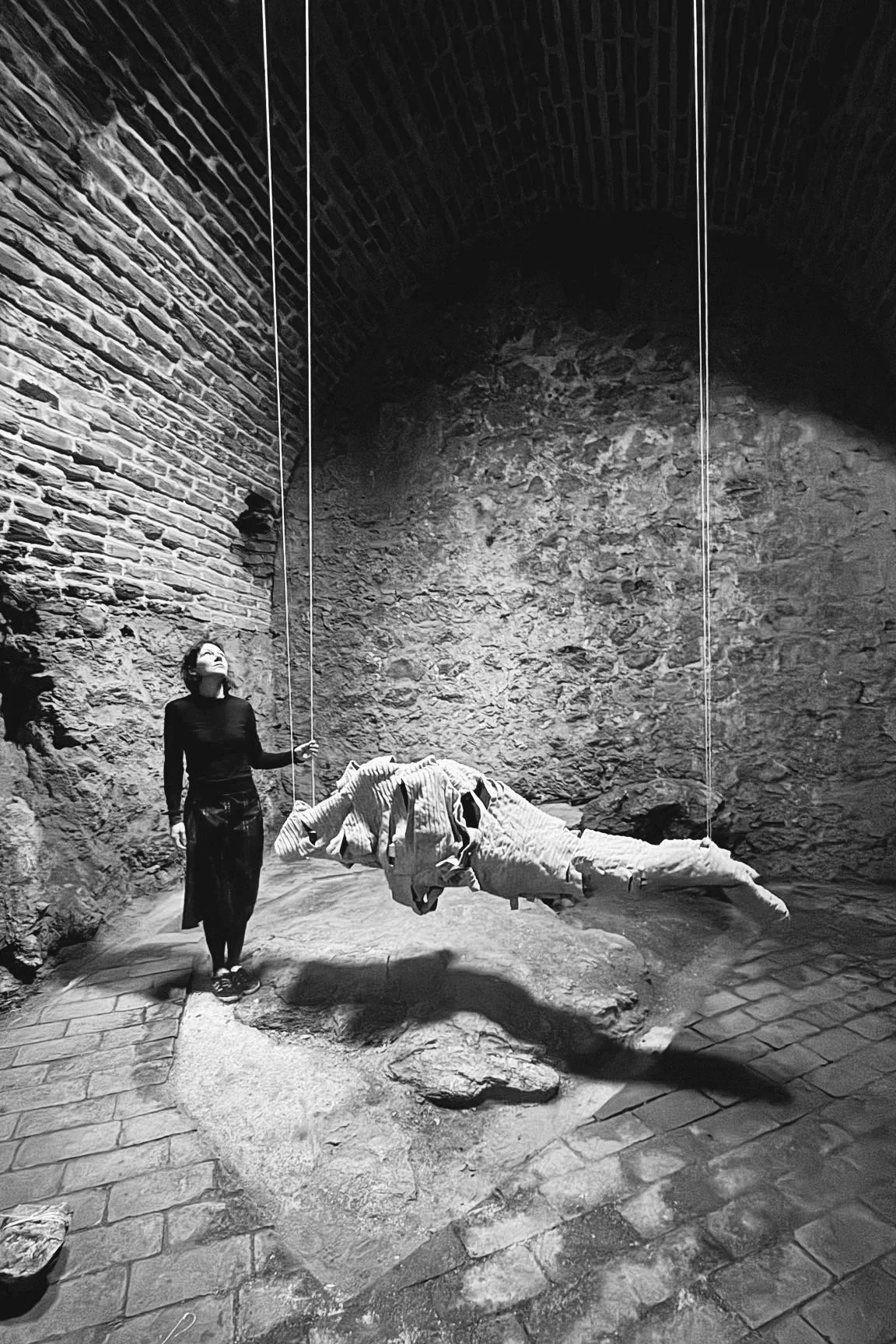
BIO
B. 1977, Cape Town, South Africa
Tina Marais is a Canadian visual and textile artist, she lives and works in Lyon, France. Her practice explores time, memory, and the entangled relationships between human and ecological systems. Through textile-based processes, Marais brings together theoretical research, tactile craftsmanship, and conceptual inquiry to create works that reflect cycles of transformation, fragility, and resilience within natural and social environments. Drawing on reclaimed materials and slow, labor-intensive techniques, her work evokes states of transition, where decay and regeneration, loss and repair, coexist, while questioning dominant colonial and capitalistic paradigms.
Marais has an extensive international exhibition record. Her work has been presented in numerous solo exhibitions, including Unfoldings and Entanglements at Gallery 76, Sydney, Australia; Les Fragments de l’Eau, Montréal, Canada; Enchevêtrements at the Fine Arts Center Gallery, Arkansas State University, USA; and Filature at Galerie 7, Lyon, France. She has participated in over 70 group exhibitions and biennials across Canada, the United States, Brazil, Belgium, China, Ukraine, Switzerland, South Korea, South Africa, Spain, Poland, France, Colombia, Lithuania, Slovenia, Australia, Portugal, and Uruguay.
Notable biennial and international invitations include BIEN, Textile Art Biennial, Slovenia (2021); Material Thinking Biennale, Tsinghua University, Beijing, China; World Textile Art Biennale, Miami, USA (2022); and Biennale Révélations at Galerie Collection, Paris (2023).
Her practice is further supported through research and creation residencies, including Contextile Biennial, Portugal (2022); La Fonderie, Paris (2024); and residencies at Place des Arts and Art Souterrain in partnership with the Montréal Museum of Fine Arts. Marais also maintains a public art practice and has completed works under Québec’s Art Public 1% program of the Ministry of Culture and Communications.
Alongside her studio practice, Marais works as a lecturer and cultural mediator. She has led over 80 community-based projects and has presented her work at international conferences. Her contributions have been supported by the Canada Council for the Arts and the Conseil des arts et des lettres du Québec since 2012. She is the recipient of several distinctions, including the Dora and Avi Morrow Fellowship for Excellence in Visual Arts (2019–2020), the Joyce Melville Memorial Scholarship (2021), Concordia University, Montréal, and the Artist in the Community Award (2021) from the Conseil des arts et des lettres du Québec for the Rassemblement project.
Education:
Visual Communication, Open Window Art Institute, South Africa (1997)
Master of Fine Arts, Fiber and Material Practices, Concordia University, Montréal (2022)
ARTIST STATEMENT
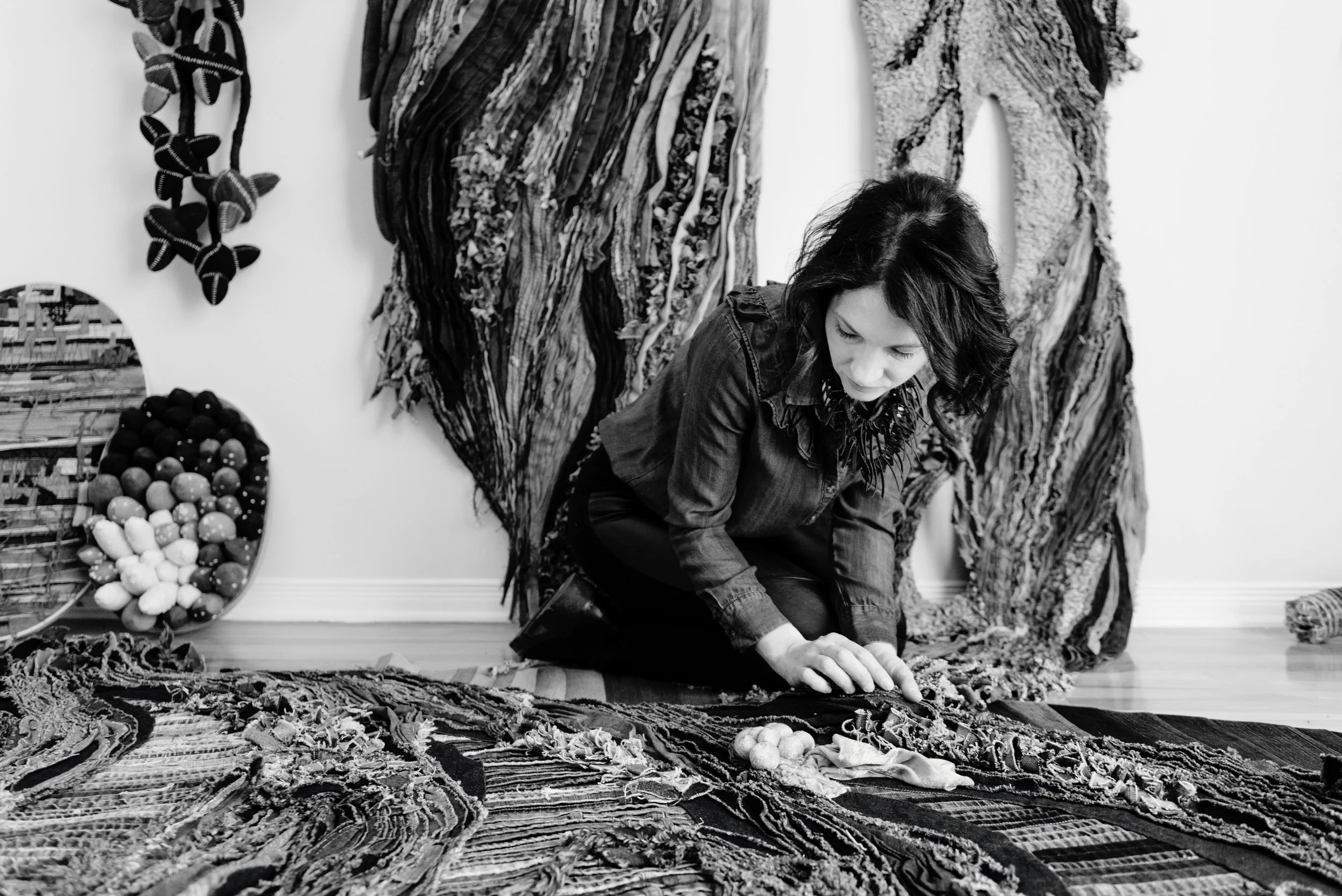
Tina Marais’ practice is rooted in research-creation at the intersection of sculpture and installation. She develops a deeply tactile relationship with materials, approaching them as spaces of memory, transformation, and relation, developing a tactile language through which forms emerge as layered, topographical compositions at once intimate and expansive. Her research explores connections between humans and environments, considering landscapes as living, stratified structures, comparable to layers of skin, where displacement, transformation, and lived experiences are inscribed.
Her works emerge through processes of observation, collection, and manipulation of heterogeneous materials drawn from natural and manufactured contexts. These elements are approached as carriers of histories and interactions, revealing dynamics of circulation, erosion, and change. Through assembling, compressing, hybridizing, and placing materials under tension, she develops forms that oscillate between surface and volume, evoking unstable topographies, organic formations, and shifting landscapes.
Folding constitutes a central language in her work, both as gesture and mode of thinking. It operates as a transformative action that conceals and reveals, protects and exposes, while generating rhythms and stratifications. Layers overlap and shift, suggesting processes of erosion, growth, and displacement. The fold becomes a way of addressing territory, migration, and environmental transformation, where boundaries between body, landscape, and matter begin to blur.
Grounded in a physical and experimental approach, her practice emphasizes gesture, manipulation, and the resistance of materials. The act of making becomes a site of interaction in which matter actively participates in shaping form. This approach engages with contemporary materialist perspectives, attentive to relationships between human and non-human forces and to the dynamics that shape environments.
Her work examines notions of displacement, adaptation, and coexistence, while exploring memory embedded within materials and landscapes. It proposes forms that evoke sensitive, unstable terrains in transformation, where organic structures intersect with constructed systems.
Through this exploration, Tina Marais develops a practice that considers sculpture as a relational space, where matter, body, and environment interact. Her works unfold as hybrid territories, revealing visible and invisible connections and inviting a reconsideration of our relationship to place, shifting environments, and the dynamics of movement.